

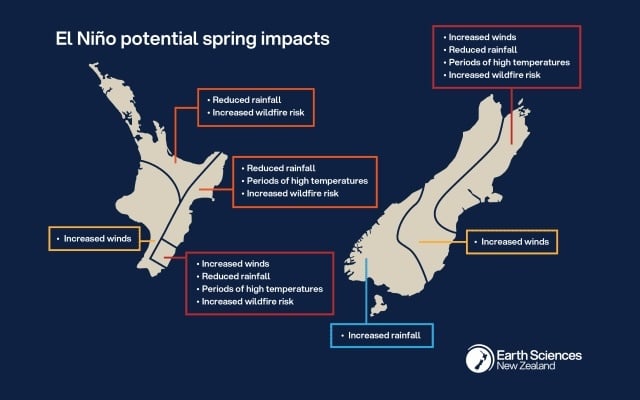
As spring approaches, growers and farmers across the Bay of Plenty, South Waikato and Central Plateau are watching seasonal forecasts closely. From kiwifruit orchards around Te Puke and Tauranga to pasture, maize and forestry operations around Tokoroa and Taupō, many are asking the same question: what if this spring turns drier than normal?
With El Niño forecast to bring warmer temperatures and an increased likelihood of below-average rainfall to many northern and eastern regions, now is the time to think beyond irrigation and ask a more important question:
How well will your soil hold onto the water it receives?
We can learn from what's happening overseas
While we're preparing for spring, growers across the Northern Hemisphere are already experiencing the kinds of conditions many parts of New Zealand could face in the months ahead.
This summer, vineyards across southern Europe, orchardists in California and grain growers in parts of Canada have battled prolonged heatwaves and below-average rainfall. Although their farming systems differ from ours, the challenge is familiar: making every drop of water count.
Increasingly, growers are recognising that resilience isn't just about having enough water to irrigate - it's about how effectively their soil captures, stores and supplies that water to plant roots. Farms with healthy soil structure and higher levels of organic matter are generally better equipped to absorb rainfall, reduce runoff and retain moisture between rain or irrigation events.
The same principle applies here in New Zealand. Whether you're growing kiwifruit in the Bay of Plenty, managing pasture near Tokoroa or producing maize around Taupō, the condition of your soil plays a major role in how well your farm or orchard copes when dry conditions arrive.
That's why your soil is one of the most valuable water storage assets on your farm.
Soil is your largest on-farm water reservoir
Most people think of dams or irrigation ponds as water storage.
In reality, your biggest water reservoir is often right beneath your feet.
Healthy soil develops a network of pores created by earthworms, roots and microorganisms. These spaces allow rainfall to soak into the soil rather than running off the surface, while also storing water that plants can access between rainfall events.
When soil becomes compacted or loses organic matter, those pore spaces decline. Water infiltrates more slowly, runoff increases, and the soil dries out more quickly once the weather turns warm.
Research published in the Agronomy Journal concludes that restoring soil organic matter can increase plant-available water and improve the resilience of agricultural systems to drought, particularly as climate variability increases.
Building resilience starts before the dry weather arrives
One of the biggest misconceptions is that drought resilience can be created once dry conditions arrive.
In reality, resilient soils are built over time.
Around the world, growers are increasingly investing in practices that strengthen soil health before seasonal dry periods, including:
- increasing soil organic matter
- applying composts and other organic amendments
- reducing unnecessary soil disturbance
- maintaining living roots through cover crops
- encouraging beneficial soil biology.
These practices all work towards the same goal: creating soils that absorb, store and cycle water more effectively.
New Zealand research tells a similar story. Manaaki Whenua – Landcare Research has invested heavily in improving our understanding of soil water-holding capacity through its S-map programme, recognising that different soils have very different capacities to store water for plants. This research helps farmers and growers better understand available water, irrigation demand and how soil properties influence resilience during dry periods.
Where vermicast fits
At MyNoke, we see vermicast as part of this long-term approach to building healthier soils.
Produced naturally by earthworms, vermicast contributes stable organic matter, beneficial microorganisms and biologically active compounds that help improve soil structure over time.
Improving soil structure can help deliver significant benefits:
- improved infiltration after rainfall
- better moisture retention within the root zone
- stronger root development
- reduced surface crusting and runoff
- increased biological activity that supports nutrient cycling.
Rather than replacing irrigation, healthy soil helps make better use of every millimetre of rainfall and every litre of irrigation applied.
Making every drop count
No one can control the weather.
But we can influence how our soils respond to it.
As growers across the Northern Hemisphere continue to navigate another hot, dry season, their experience offers a timely reminder for New Zealand: investing in soil health before dry conditions arrive is far more effective than reacting once they do.
Whether you're growing kiwifruit, avocados, maize, vegetables or managing pasture across the Bay of Plenty and central North Island, healthy soil is one of the best long-term investments you can make in your farm or orchard's resilience.
This spring, don't just think about how much water you'll have.
Think about how much your soil will keep.
With worm farms in Tokoroa and Taupō, MyNoke works with growers, farmers and landscapers throughout the Bay of Plenty and central North Island to build healthier, more resilient soils. Spring is one of the busiest times of year for soil preparation. If improving water retention and building healthier soils is part of your plan this season, now is the ideal time to secure your vermicast ahead of the spring rush.
Want to apply vermicast ahead of the dry season? Get in touch to secure your order now, ahead of spring.